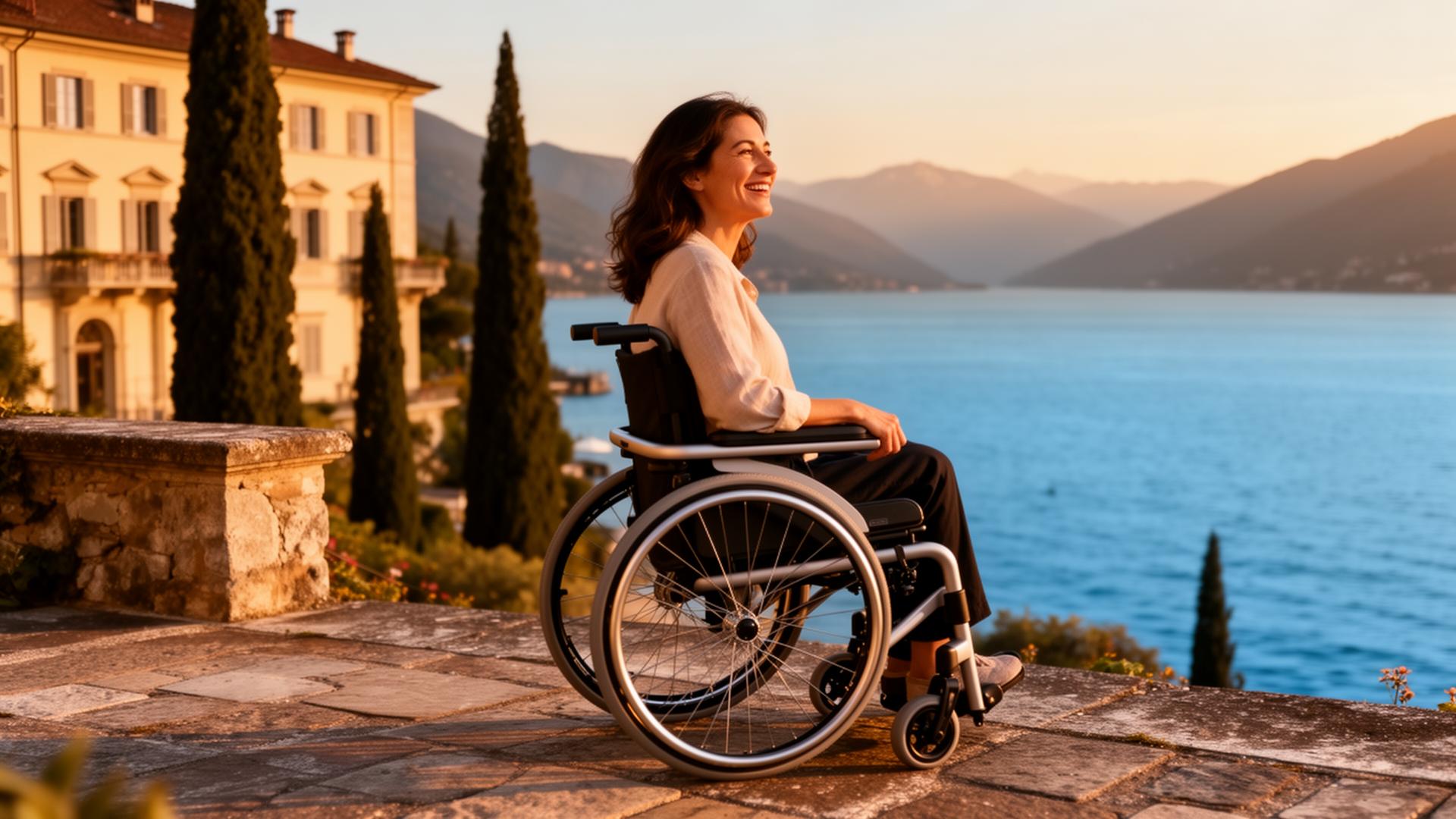
Italy rewards travellers who plan well and punishes those who trust a booking-site checkbox. 'Accessible room' can mean a roll-in shower with grab rails, or it can mean a standard room on the ground floor with a 62 cm bathroom door. The Access Key exists to close that gap: we ask the questions you would ask, in Italian, before you pay for anything.
What accessible travel in Italy actually looks like
- Milan — flat grid streets, metro lines M1, M3 and M5 fully accessible, Duomo rooftop reachable by lift
- Lake Como — the car ferries operated by Navigazione Laghi are step-free, and the Como, Menaggio and Bellagio lakefronts are largely flat
- Rome — free entry for wheelchair users and one companion at the Vatican Museums and major state sites, with dedicated lift entrances
- Florence, Venice, Amalfi Coast — possible, but they need a route-by-route plan rather than a generic itinerary
Accessibility in Italy is not distributed evenly. Nineteenth- and twentieth-century cities built on a grid — Milan above all — are broadly step-free and well served by lifts. Ancient and medieval centres are a different problem: basalt cobbles, single-step thresholds, historic lifts too small for a power chair. The practical answer is almost never 'this city is accessible' or 'this city is not'; it is which neighbourhood, which entrance, which vehicle and which time of day.
The three things that decide whether a trip works
1. The bathroom, not the room
The most common failure point is the bathroom door width and the shower threshold, not the bedroom. Ask for the clear door opening in centimetres, the shower entry type (roll-in, low lip, or bathtub), and whether grab rails are fitted next to the toilet and inside the shower. A photograph of the bathroom taken today is worth more than any accessibility badge.
2. The transfer chain
A perfect hotel is useless if you cannot get to it. Wheelchair-accessible vehicles (WAVs) in Italy are a limited fleet and are booked out early around Easter, Milan Design Week, the fashion weeks and August holidays. The transfer is usually the first thing to lock in, not the last.
3. Written confirmation
Verbal reassurance from a reservations desk is not a booking condition. We ask operators to confirm accessibility details in writing, attached to your reservation, so there is something to point at on arrival.
How our concierge works
- Free concierge assistance — questions in your language, destination suitability, route and itinerary guidance
- Verified Accessibility Check from €99 — we contact the property directly and confirm door widths, lift dimensions, shower type and transfer compatibility
- On-site inspection on request — a physical visit before you travel, quoted case by case
We publish only what we have confirmed ourselves or what an operator has stated directly to us. Anything that is not verified for your specific dates, room or vehicle is planning guidance, not a guarantee — our concierge confirms the details in writing before you commit.
Who we plan for
- Manual and power wheelchair users, including larger power chairs that many historic lifts cannot take
- Travellers with reduced mobility who walk short distances but cannot manage steps or long standing
- Senior travellers who need pacing, seating, shade and shorter transfer legs
- Families and companions travelling with someone who needs step-free access
Frequently asked questions
Is Italy good for wheelchair users?
Italy is very travellable with a wheelchair, but accessibility depends heavily on the city and the individual building. Milan is the most consistently step-free major city; Lake Como works well thanks to step-free car ferries and flat lakefronts; Rome's major sites offer lift access and free admission for wheelchair users plus a companion. Historic centres with cobbled paving and older buildings need route-specific planning.
What is the easiest part of Italy to start with?
Milan combined with Lake Como. Milan has flat grid streets and accessible metro lines, and Lake Como is reachable by accessible train or van transfer, with step-free car ferries connecting the lakeside towns.
Can you guarantee a hotel is accessible?
We do not publish guarantees on behalf of hotels. We verify specific details with the property — door widths, shower type, lift dimensions, grab rails — and give you the operator's written confirmation. If a detail cannot be verified, we say so plainly instead of assuming.
How far in advance should I plan?
For accessible rooms and wheelchair-accessible vehicles, three to six months is comfortable. Around Easter, Milan Design Week in April, the September fashion weeks and the August holidays, accessible inventory disappears first — plan earlier for those periods.